
Monster Hunter · Figure guide
Nargacuga Figure
Nargacuga can turn a short distance into an attack before a hunter has finished reacting. Its low body gathers into sudden leaps, while the long tail threatens far beyond the reach of its face. Fighting it makes the space around the whole creature matter.
That movement gives Nargacuga figures their connection to Monster Hunter. The dark body and sharp wing edges identify the monster, but a crouch or a raised tail can also recall the point in a hunt when the next movement becomes difficult to predict.
Story and characterFigure selection
Articulated hunting stance
Bandai · S.H.MonsterArts

S.H.MonsterArts Nargacuga
View this figureThe low body and long tail in an adjustable S.H.MonsterArts figure.
Review the supplied parts and supports against the low stance you want to create. Check the current offer on the exact product page.
Raised-tail sculpture
Capcom · Creator’s Model · Reissue
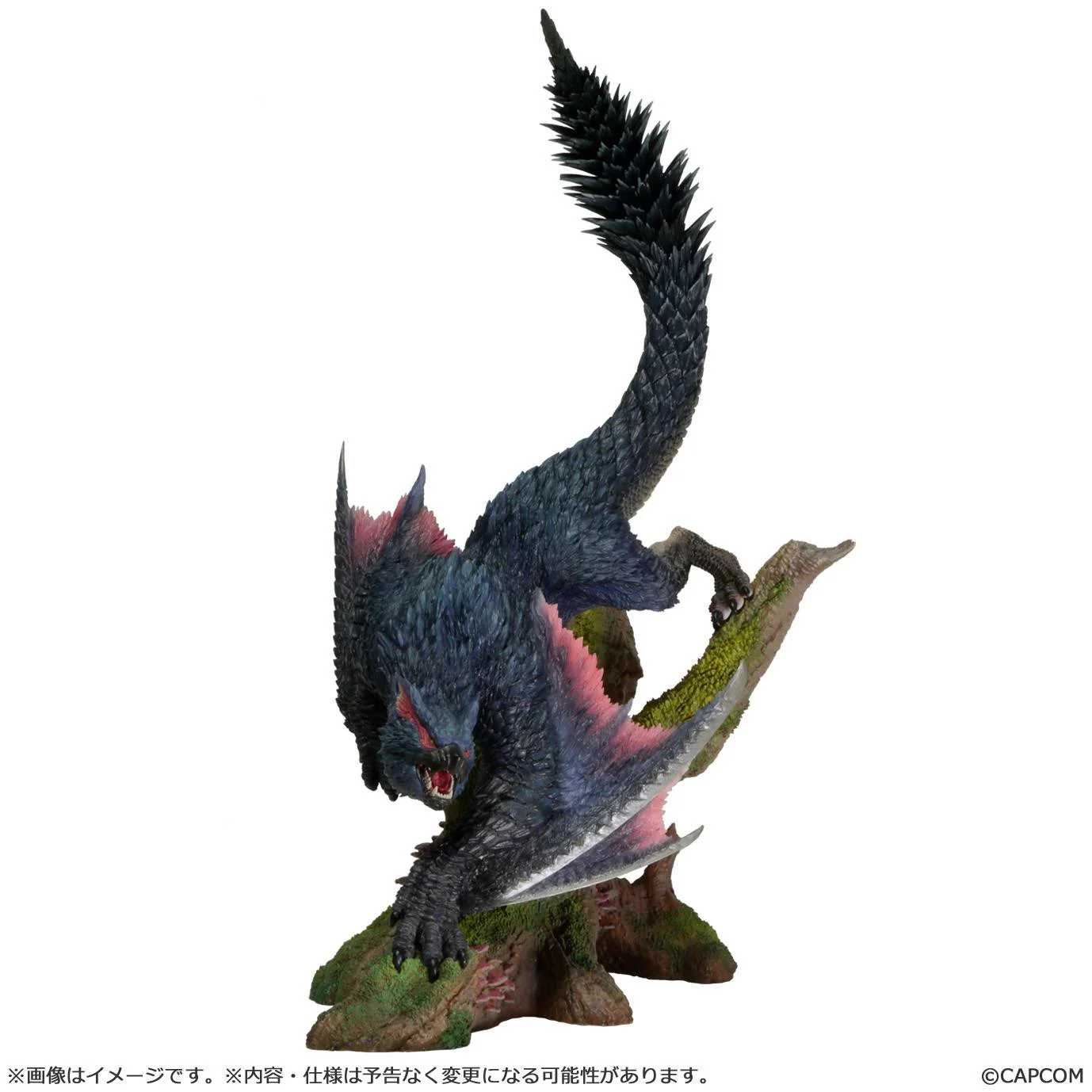
Nargacuga Creator’s Model
View this figureNargacuga holds a fixed full-body pose above a natural-looking support, with the tail lifted high.
Include the support and upright tail when measuring the display space. The composition needs height as well as room around the creature.
Frontal prize figure
Banpresto · Prize figure · Second hand

Shadow of the Jet-Black Night
View this figureBanpresto’s Shadow of the Jet-Black Night brings the face and wing blades into a compact frontal presentation.
This offer is second hand. Read the item and box condition for the particular copy before ordering.
Story and character
A flying wyvern with a fast ground game
Nargacuga is classified as a Flying Wyvern, yet much of its identity comes from agility close to the ground. Sudden changes of position make it difficult to treat the fight as a steady exchange in one place.
Capcom’s monster description emphasizes its speed, surprise attacks and sharp wing blades. These traits work together: the body can close a gap quickly, and the hard edges along the forelimbs make that approach dangerous.
The resulting silhouette has a practical connection to how it moves. A lowered body, forward limbs and tail held behind it suggest a creature ready to spring. The anatomy supplies the tension without needing fire or an electrical display.
The tail remains part of the attack
The tail gives Nargacuga a reach that extends well beyond the head. Turning, sweeping and slamming it can threaten a hunter who has avoided the initial approach. Getting out of the way of the face does not remove the rest of the creature from the encounter.
In Capcom’s announcement of its return for Iceborne, the deadly tail slams are part of the reminder of what players had faced before. The monster’s identity survives the move to a different environment through that familiar rhythm of movement and attack.
A portrayal that emphasizes the tail can therefore recall an active threat rather than an extra length of body. Its position belongs to a creature whose next movement can change the area that is safe to occupy.
An encounter carried from one game to another
Nargacuga was a flagship monster for Monster Hunter Freedom Unite before returning in later entries, including Iceborne. A returning species gives experienced players something recognizable while introducing it to people arriving through a different game.
Lucent Nargacuga is a distinct rare species
Lucent Nargacuga changes more than the color of the familiar creature. Capcom describes its pale fur refracting moonlight to let it disappear from view, making the ability part of the monster’s biology.
Its name therefore identifies a particular encounter within the Nargacuga family. The dark form and the pale, elusive rare species share a connection, while each has its own appearance and behavior.
Nargacuga’s appearance carries the expectation of movement. The crouch, wing blades and long tail make sense together as the body of a fast predator, with danger extending into the space around it.